
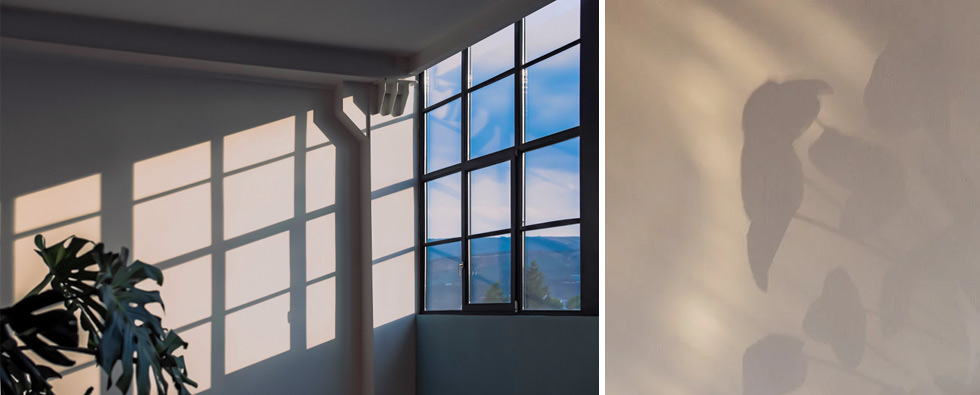
Facades for Natural Light
Humans tend to spend most of the time indoors therefore it is essential that buildings and homes incorporate natural light as a fundamental part of their environmental conditions. Natural light makes dwellings more attractive, Beautiful and energy-efficient while improving sleep, increasing comfort and being Connected to the outside for the user.
Daylighting is typically used to describe the controlled use of natural light in and around buildings. This usually involves the practice of placing windows, or other transparent media and reflective surfaces to utilise natural light to illuminate the building.
Daylighting design needs to consider orientation and building site characteristics, facade and roof characteristics, size and placement of window openings, glazing and shading systems, geometry and reflectance of interior surfaces. Good daylighting design ensures adequate light during daytime
The objectives of daylighting are to illuminate visual everyday tasks, to create an attractive visual environment and to provide the light needed for our biological needs. A good luminous environment is simultaneously comfortable, Beautiful, pleasant, and appropriate for its intended uses and users. It gives positive effects on learning, social behaviour, and emotional wellness.
Daylight is also a way to minimise electricity consumption used for artificial lighting as well as heating and cooling loads. Daylight is one of the easiest and cheapest energy efficient measures to implement. Therefore, to achieve the highest possible savings and ensure the design is Affordable in terms of assets and energy, full advantage of natural light needs to be taken.
Housing layouts should be designed to maximise daylight and sunlight while considering other factors, such as privacy and the attractiveness of the wider streetscape. Buildings can be illuminated via the use of Skylights, atriums and solar tubes that utilise natural light to provide effective lighting levels within the building while establishing the feeling of being Connected to the outside.
A building’s form, orientation and window proportions are all aspects that if optimised within the design, can significantly improve the building’s efficiency. The orientation and massing of the building should be optimised, if possible, to allow useful solar gains and prevent significant overshadowing in winter. Encourage south facing dwellings with solar shading and prioritise dual aspect. Overshadowing of buildings should be avoided as it reduces the heat gain from the sun in winter.
Solar energy generation relies on the layout and orientation of roofscapes to maximise opportunities for solar PV generation. Effort should be made to try and maximise the potential of Photovoltaics with south facing roofscapes.
Getting the right glazing-to-wall ratio on each façade is a key feature of energy efficient design. Minimise heat loss to the north (smaller windows) while providing enough solar heat gain from the south (larger windows). It is much easier to design smaller windows facing access decks and larger windows facing balconies. Therefore, from a design perspective, it is recommended to orientate access decks to the north and balconies to the south.
The design of a deck or balcony is an opportunity to provide an interesting and Accessible 3D element. This must be balanced against the need for privacy, sun control and thermal comfort.
Design Principles
- Ensure glazing areas are not excessive i.e. not more than 20-25% of facade on south or west façades to avoid overheating.
- Glazed openings of an area equal to at least 1/15th of the relevant floor area of the associated room.
- Avoid fixed panes and maximise opening areas of windows. Side hung windows typically allow more ventilation than top hung.
- Favour dual aspect homes to allow cross ventilation.
- Provide appropriate solar shading. South façades should preferably have horizontal shading over the window and the west façade should ideally have movable vertical shading e.g. shutters.
- Avoid relying on internal blinds, which can be removed by residents.
- Select a g-value (the solar factor indicating how much heat is transmitted from the sun) for glass of around 0.5 where possible.
Always refer to relevant building standards and local council policy for the minimum requirements.