
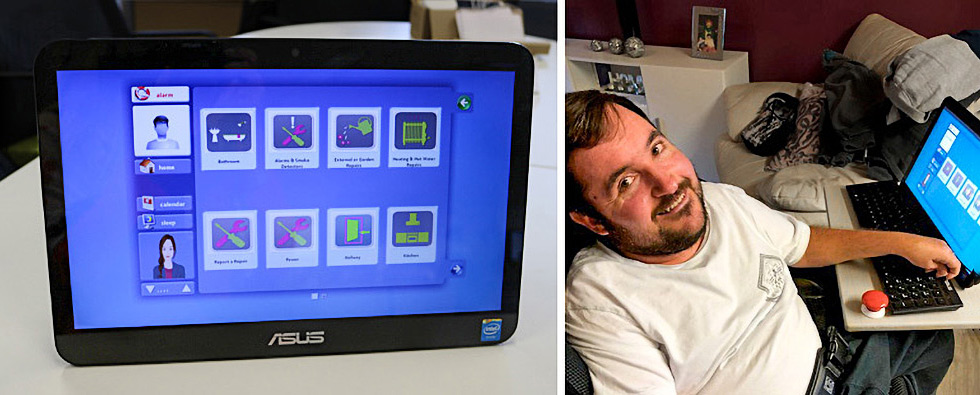
What is a smart home?
A smart home offers the ability to control appliances and devices remotely giving greater choice and control over the home environment at the touch of a button, or by merely saying certain words out loud.
In a smart home you can interact with what you want, when you want and on whatever device you want, but it also offers the ability to non-intrusively monitor health and safety without you doing anything. A suite of interconnected devices, powered by built in internet connectivity, can monitor inactivity or an accident and raise an alarm, or when linked to wearable devices, automatically send heath data that triggers an intervention.
The use of WiFi enabled devices throughout the home minimises the need for surface mounted sockets that have traditionally been required to facilitate home automation. This maintains the contemporary look and feel of the Blackwood House while ensuring it remains state of the art.
Battery-powered sensors area easy to install, portable and don’t need cabling everywhere. Infrared motion sensors will track movement, door/windows sensors will tell you whether you’ve left anything open while smart smoke alarms will sniff out the signs of a fire. Wireless smart locks are also starting to appear, enabling you to ditch your house keys in favour of PIN pads and fingerprint sensors. Smart doorbells and entry systems use facial recognition to allow entry for you and visitors without having to leave your chair.
Smart homes offer lots of security features, with low cost Wi-Fi cameras and sensors you can monitor your home from the other side of the world, or with a smart cat flap you can let the kitty indoors while your in the supermarket.
Smart homes offer convenience and cost savings. While traditional heating timers switch your boiler on and off at pre-set times regardless, smart thermostats use AI to learn how you heat your home and act accordingly giving greater control of energy use. Zonal control enable you to heat different rooms to the temperature that suits you so for example bedrooms can be cooler than living spaces. Smart appliances can be setup to operate when energy costs are at their lowest when coupled with flexible tariffs.
Conversational artificial intelligence lets you control devices with voice commands – “turns the kitchen light on, open the blinds, play my doing the housework playlist”.
Connected homes offer the ability to live independently by being able to control the environment regardless of mobility or dexterity, robot hoovers, lights, blinds or lowering kitchen worktops.
Adding smart plugs lets you control non-smart objects in smart ways. Plug a smart plug into a mains socket and it will control the flow of electricity to whatever is plugged into it – a heater, a lamp, a fan, etc – allowing you to switch them on/off remotely.
Connected homes also allow maintenance to be managed remotely such as monitoring communal lights and autonomously raising a repair, allowing access to the building from a central control room or monitoring humidity levels.